

You Aren’t Always Getting the High RTP Slot Game Version at Your Favourite Casinos
When you play a slot game, you expect a fair and mathematically verified chance to win. Many players assume that a slot game has a single, fixed Return to Player (RTP) percentage, permanently set by its software developer. For instance, if NetEnt’s Starburst is widely known for its 96.09% RTP, it’s natural to assume this figure applies wherever you play the game. However, this is not always the case.
To understand why, let’s first clarify what RTP means. RTP is a theoretical percentage that indicates how much of all wagered money a slot machine will pay back to players over time. For example, if you wager $100 on a slot game with an established RTP of 96%, the game is mathematically designed to return $96 to players. It’s crucial to remember that this return is purely theoretical and is calculated over millions of spins; it’s a long-term average and does not guarantee short-term individual results. In a single session, you could win big or lose your entire bankroll.
The critical issue for modern online slot gaming is that, due to flexible software configurations, game studios now ship their most popular titles with variable RTP ranges. This means an online casino can choose whether to offer you the high, medium, or low payout version of the exact same slot game. A slight reduction in the base RTP—say, from 96% down to 91%—dramatically increases the casino’s house edge, causing your playing budget to drain far faster than you might expect.
In this comprehensive guide, we will pull back the curtain on variable RTPs, explain why casinos alter these settings, and show you exactly how to verify the real, active RTP on your screen before you spin, ensuring you’re always getting the best possible theoretical return.
Understanding RTP: The Foundation of Slot Gaming Returns
Before exploring how online casinos manipulate payout percentages, it is essential to establish a firm understanding of what Return to Player (RTP) actually means and how it influences your gameplay. At its core, RTP is the mathematical inverse of the house edge. If a slot game has a certified RTP of 97%, the house edge is exactly 3%. This means that over an infinite timeline of wagering, the casino expects to retain 3% of all action, while distributing the remaining 97% back to the betting pool in the form of line wins, bonus features, and progressive jackpots.
However, the most common mistake made by casual slot players is misunderstanding the relationship between RTP and short-term volatility. The theoretical RTP of a slot is calculated across a massive cycle of spins—often ranging from 10 million to 10 billion game rounds. This long-term scale is required to satisfy the Law of Large Numbers, ensuring that the random variations of the game’s Random Number Generator (RNG) eventually smooth out into the exact targeted percentage.
In a typical gaming session consisting of 500 or 1,000 spins, the actual return you experience will vary wildly from the theoretical RTP. You may hit a high-paying free spins round early on and experience an actual session return of 500%. Conversely, you might experience a long dry spell where your session return is closer to 30%. This variance is controlled by the slot’s volatility (or variance) rating. High-volatility slots pay out less frequently but offer larger maximum wins, while low-volatility slots offer frequent, smaller payouts.
Because of this high short-term volatility, many players fail to notice when a casino has quietly swapped a high-RTP version of a slot for a lower one. A player losing their bankroll on a 91% RTP game will simply chalk it up to “bad luck” or “high volatility,” unaware that the math of the game was heavily stacked against them from the very first spin. Over weeks, months, and thousands of spins, however, playing a downgraded RTP version will inevitably result in fewer winning sessions, shorter play times, and a rapidly depleting bankroll. This is why knowing how to verify the active RTP of your game is the single most important skill a modern slot player can possess.
How to Verify a Slot Game’s RTP: Your Step-by-Step Guide
When it comes to verifying the actual mathematical configuration of an online slot, you cannot rely on memory, marketing banners, or general review sites. You must learn how to audit the game in real time. Fortunately, regulatory compliance rules require casinos to make this information accessible, though it is often hidden behind layers of menus. Below is a step-by-step guide to finding the true, active RTP of any slot game, ordered from the most reliable method to secondary verification sources.
The Most Reliable Source: In-Game Information
The single most trustworthy, accurate, and legally binding source for a slot’s active RTP is the in-game help file or paytable screen. This file is loaded directly from the game provider’s servers alongside the game itself, meaning it must reflect the exact software version currently running on the casino’s platform. If a casino has selected a lower RTP build, the game provider is legally required to update the in-game help documentation to show that specific number.
To find this information, follow these steps when you load any online slot:
1. Open the Game: Launch the slot in either real-money or demo mode. The RTP configuration remains identical across both modes on licensed platforms.

2. Locate the Interface Menu: Look for the settings panel. This is usually represented by a gear icon, a hamburger menu (three horizontal lines), an “i” (information) button, or a question mark (?) icon located in the bottom corners of the game screen.

3. Differentiate Between Paytable and Help Rules: Do not just look at the standard paytable, which displays symbol payouts and bonus explanations. You need the comprehensive “Help” or “Game Rules” file, which typically opens in a separate browser window or a scrolling text overlay.
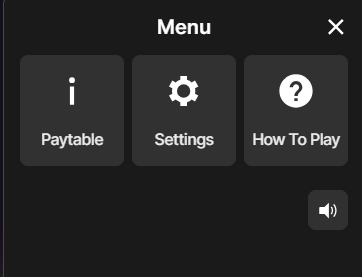
4. Search for the RTP: Scroll through the text or use your browser’s search function (Ctrl+F or Cmd+F) and type “RTP” or “Return to Player.”
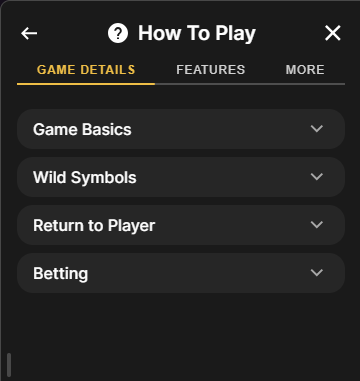
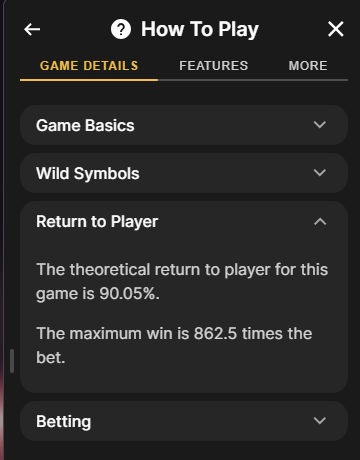
5. Verify the Percentage: You will find a sentence resembling: “The theoretical return to player for this game is 96.21%.” If you see a number like 94.20% or 91.15% instead of the advertised industry maximum, you are playing a downgraded version.
Consulting the Game Provider’s Official Page
If you want to know what the slot *should* be paying at its absolute peak performance, your next step is to visit the official website of the software developer who created the game. Major studios like NetEnt, Pragmatic Play, Play’n GO, and Relax Gaming host detailed game specification sheets for their entire portfolios.
On these developer portals, you can look up a game’s profile to find its maximum designed RTP, along with its volatility rating, hit frequency, and maximum win potential. While this page will show you the optimal configuration of the game, remember that it does not guarantee your chosen casino has purchased or installed the highest-paying version. It merely serves as your baseline benchmark. If the provider’s official page states that a slot has a maximum RTP of 96.50%, but your casino’s in-game help file lists 94.50%, you know immediately that the casino has selected a lower-tier build.
Trusting Third-Party Certifications and Databases
To maintain their operating licenses in highly regulated markets such as the United Kingdom, Malta, Gibraltar, and various North American states, online casinos must submit their games to independent, accredited testing laboratories. Renowned agencies such as eCOGRA (eCommerce Online Gaming Regulation and Assurance), GLI (Gaming Laboratories International), and iTech Labs perform rigorous audits of the random number generators and actual payout percentages of online casinos.
Many reputable casinos display the trust seals of these testing labs on their website footers. By clicking these logos, you can often view certified, real-world RTP audits for the casino’s entire game library over a specific month or quarter. Additionally, you can cross-reference slot statistics using reliable, independent gambling databases and slot review portals. However, always treat database listings as secondary indicators. If there is ever a discrepancy between a database, a review site, and your active in-game help file, the active in-game help file is the only figure that represents your current game session.
Why You Might Not Be Getting the High-RTP Version
Now that you know how to find the RTP of a slot, we must address the most pressing question: why does the same game exist in multiple versions? In the early days of online gambling, game developers designed a slot with a single, unalterable math profile. If a casino wanted to host a game, it had to accept the RTP set by the developer.
In recent years, however, the business model of online slot development has shifted dramatically. Under pressure from casino operators who wanted more control over their profit margins, game studios began developing and shipping their games with multiple RTP tiers. Today, when a studio launches a blockbuster slot, they do not just release one game file; they release a package containing several different RTP configurations.
For example, a premium slot might be delivered to casinos with five distinct options: a high option (~96.5%), a medium-high option (~94.5%), a medium option (~92.0%), a low option (~90.0%), and an ultra-low option (~88.0% or lower). The visual assets, the sounds, the bonus features, and the hit frequencies remain completely identical across all versions. The only thing that changes is the underlying mathematical distribution of payouts. The player cannot see or feel any difference in gameplay; the slot simply awards slightly fewer or smaller wins over time, allowing the casino to retain a larger share of the total wagers.
To illustrate just how widespread and significant these differences are, let us look at real-world examples from the industry’s most prominent game studios. The table below details the variable RTP ranges that popular slot games are shipped with, demonstrating how much value you could be losing depending on where you choose to play.
| Software Provider | Slot Game Title | Maximum RTP (High) | Medium RTP Tier | Low RTP Tier | Minimum RTP Tier |
|---|---|---|---|---|---|
| Play’n GO | Book of Dead | 96.21% | 94.25% | 91.25% | 87.25% / 84.25% |
| Pragmatic Play | Gates of Olympus | 96.50% | 95.51% | 94.50% | 89.51% |
| NetEnt | Starburst | 96.09% | 95.05% | 94.05% | 92.05% / 90.05% |
| Red Tiger Gaming | Gonzo’s Quest Megaways | 96.00% | 94.70% | 92.70% | 90.70% |
| Play’n GO | Reactoonz | 96.51% | 94.51% | 91.51% | 87.51% / 84.51% |
As the table clearly shows, the difference between the highest and lowest tiers is staggering. If you play Play’n GO’s iconic Book of Dead at a casino that uses the maximum 96.21% version, the house edge is a reasonable 3.79%. However, if you play the same game at a casino that has opted for the 87.25% version, the house edge climbs to 12.75%—more than triple the original rate! Your bankroll will deplete three times faster on the lower-tier version, resulting in a significantly degraded entertainment experience and virtually destroying your chances of walking away with a profit.
The Casino’s Choice: Why Lower RTP Versions Exist
It is easy to look at these variable RTP ranges and label casino operators as greedy. While profit-seeking is obviously a primary driver, the reality of the situation is more complex. The decision to run lower RTP versions of slots is often a direct response to the economic and regulatory realities of running a modern online casino.
Over the past decade, the global online gambling market has transitioned from a largely unregulated “Wild West” to a highly taxed, heavily regulated landscape. In countries like the United Kingdom, Sweden, Germany, and various states in the US and Canada, operators must pay high licensing fees, strict compliance penalties, and substantial point-of-consumption taxes. For example, Germany’s interstate treaty imposes a hefty 5.3% tax on every single slot wager (not just on net revenue). To survive in such low-margin environments, casinos must find ways to lower their operating costs and increase their hold. Adjusting slot RTPs down to 90% or 92% is one of the most effective levers they have to offset these local tax burdens.
Furthermore, running an online casino involves massive overhead costs. Operators must pay high platform fees to game aggregators, pay substantial royalties to game developers, fund expensive marketing campaigns to acquire new customers, and cover transaction processing fees for deposits and withdrawals. When an online casino offers lucrative welcome packages, such as 100% deposit matches or hundreds of free spins, they are taking on a massive upfront financial risk. To recoup these promotional costs, many casinos quietly lower the RTPs of their slot libraries, effectively shifting the cost of their “free” bonuses back onto their regular players over the long run.
Taking Control: How to Always Find the Best RTP
As a player, you are not powerless in this situation. The key to protecting your bankroll is to adopt a proactive, defensive playing style. By shifting your approach from passive entertainment to informed consumer choice, you can ensure that you only play slots when they are configured to deliver their maximum possible return.
Here is a checklist of actionable steps you should take every time you play:
- Develop the “Audit Habit”: Never assume a slot is set to its default RTP. Make it a strict habit to open the game rules file and check the percentage before placing your very first bet. This audit takes less than thirty seconds but can save you hundreds of dollars.
- Vote with Your Wallet: If you perform an audit and discover that your favourite casino is running a downgraded version of a game (for example, a 91% version of Book of Dead), immediately close the game and log out of the casino. There are thousands of reputable online casinos; you do not have to accept unfair math.
- Keep a List of “High-RTP Casinos”: When you find an online casino that reliably runs the maximum RTP versions of popular games, add them to your preferred list. Many top-tier casinos use maximum RTPs as a selling point to attract smart, high-value players. These are the platforms that deserve your business.
- Be Skeptical of Excessive Bonuses: If a casino is offering a bonus that seems too good to be true, check their slot RTPs. Quite often, casinos that offer massive, low-wagering bonuses offset their losses by lowering the RTPs on their entire slot catalogue. Always read the fine print and audit the games.
- Consult Minimum Deposit Casinos (MDC): Use reputable, expert portal sites like Minimum Deposit Casinos to find comprehensive reviews of licensed operators. MDC reviews assess casinos on their licensing, terms, and the overall fairness and transparency of their gaming libraries, helping you avoid platforms that use predatory, low-RTP game configurations.
Conclusion: Play Smart, Play Informed
The landscape of online slot gaming has changed permanently. The era of uniform, standardised game payouts is gone, replaced by a dynamic system where casinos can adjust the math of their games to suit their own financial needs. While this system presents a challenge for players, it also provides an opportunity for those who are willing to do a little research.
By understanding what RTP is, acknowledging the existence of variable RTP tiers, and knowing how to locate the real, active payout percentage in a game’s help files, you can protect yourself from unfair setups. Do not let online casinos quietly erode your bankroll. Take control of your gaming experience, verify every game before you play, and always demand the highest possible return for your money. Play smart, play informed, and make sure every spin counts.
Latest Casino News