
Tag: Cryptocurrency
A Deeper Insight on Cryptocurrency
Consider cryptocurrency as a digital or virtual currency. This form of currency has been making headlines for some time now, and a lot many online casinos and gambling portals have started accepting cryptocurrencies, especially Bitcoin.
Cryptocurrency is highly secure and uses cryptography to rule out any odd chances of getting counterfeit. Essentially, most of the cryptocurrencies available today are based on a decentralized system powered by blockchain technology.
The first ever cryptocurrency known to use is called Bitcoin which is also the most valuable and popular cryptocurrencies. Bitcoin was launched in 2009 by an individual under the pseudonym, Satoshi Nakamoto.
Today there are more than 17.53 million Bitcoins are in circulation in the market with an estimated value of $63 billion. Bitcoin’s success has definitely set the platform for various other cryptocurrencies which have spawned up in the time being. Some of the names which have caught the attention include Namecoin, Litecoin, Ethereum, and others.
There are thousands of cryptocurrencies in existence today which enjoy a cumulative market value of $120 billion wherein Bitcoin currently reflects more than half of the market share.
What Can You Do With Cryptocurrency?
From buying goods to investing, mining, gambling, and accepting them as payment, cryptocurrencies fulfil almost all your requirements.
Legal Status of Cryptocurrencies
As cryptocurrencies are getting adopted by more and more people, related authorities and regulators are trying their best to regulate them and understand how cryptocurrencies can fit in the existing regulations and legal frameworks.
Although cryptocurrencies are secure and induce transparency, there also are a range of concerns associated with them. A lot of experts have raised their concerns related to their decentralized nature and the ability to be used anonymously. Authorities around the world fear that cryptocurrencies can be used to purchase goods and services illegally. Add to that, a lot many governments believe that the widespread use of cryptocurrencies could promote money laundering and tax evasion schemes.
All that said, cryptocurrencies have definitely emerged to be one of the easiest methods to play with on online casinos. As more and more casinos have started accepting cryptos, it will be interesting to see how the industry evolves itself in the near future.
Why Digital Currency Is Changing the Game – Kiwis Turning to Crypto Bonuses
Digital innovation is reshaping almost every part of daily life in Aotearoa – from how we shop to how we pay our bills. Now, it’s transforming how Kiwis play online too. In the past few years, NZ casinos have seen a major shift toward digital payment systems, with cryptocurrency leading the charge.
Around one in seven New Zealanders now own or have owned digital currency such as Bitcoin, Ethereum, or Tether (USDT). For a growing number of online gamers, these currencies aren’t just investments – they’re becoming their preferred way to play. Online casinos are embracing this trend, offering smoother transactions, new ways to claim rewards, and a more secure, flexible gaming experience that fits perfectly with the modern Kiwi lifestyle.
The Digital Shift in NZ Gaming
New Zealand casino gaming has always moved quickly. From mobile streaming to instant sports betting apps, there have been all sorts of innovations. Now, the next wave is coming from digital currency. As more Kiwis become comfortable using crypto wallets and blockchain technology for peer-to-peer transactions, online casinos have begun to pay attention.
Instead of relying on traditional payment methods (which can take a long time or have drawbacks coming from banking institutions), casinos are moving to crypto payments. As you will learn in this issue, crypto payments, in many cases, are not only much cheaper but they are faster, and often provide greater rewards to players partaking in depositing and withdrawing. The move to crypto gaming fits a broader perspective of how New Zealanders are rethinking money in a digital format, direct transactions, and for convenience.
Whether it’s a player in Auckland spinning the reels or someone in Queenstown trying their luck at blackjack, the appeal is clear – speed, security, and the chance to earn Bitcoin casino bonuses that go beyond what traditional sites can offer.
Why Crypto Is Changing the Game for NZ Players
So why are more New Zealand players switching to digital currency in the first place? The answer lies in flexibility, freedom, and the sheer convenience of modern payment options.
Unlike traditional banking systems, which can take days to process a withdrawal, crypto transactions are nearly instant. Players can deposit Bitcoin or Ethereum and see their funds available in minutes. Withdrawals are equally fast, often completed within the same day.
Then there’s the cost advantage. Traditional credit cards and e-wallets often come with processing fees or exchange rate costs. Crypto transactions, by contrast, typically involve minimal fees – especially appealing for Kiwis who want to maximize every dollar of their deposit.
Crypto also removes geographical barriers. Whether a casino is based in Europe, Asia, or the Pacific, digital currency allows seamless play without worrying about currency conversion or bank restrictions.
Security and privacy are additional bonuses. Because transactions are recorded on the blockchain, they’re transparent and highly secure – without exposing personal banking information. For many Kiwi players, this adds an extra layer of comfort when playing on international platforms.
The Rise of “Crypto Bonuses”
The emergence of crypto bonuses is one of the biggest highlights in online gaming recently – rewards specifically aimed at players who use digital currency. Crypto bonuses take on familiar structures, such as deposit matches, free spins, or cashback, but their defining characteristic is that they are paid in cryptocurrencies, such as Bitcoin (BTC), Ethereum (ETH), or USDT.
For example, a crypto casino might offer:
“Deposit with Bitcoin and get 20% extra bonus credit.”
Many of these platforms provide higher reward percentages for players using digital currency than for those using fiat methods. Why? Because crypto transactions are cheaper and faster for casinos to process, allowing them to pass the savings back to players.
This new wave of rewards is catching the attention of value-driven Kiwis. Whether it’s a seasoned poker fan or a casual slot player, crypto bonuses deliver more flexibility and a sense of exclusivity – perks that align perfectly with New Zealanders’ love of innovation and fair play.
These Bitcoin casino bonuses are doing more than boosting balances – they’re changing the overall player experience. Instead of waiting for slow payments or limited offers, Kiwis can now enjoy faster payouts, higher returns, and more transparent transactions.
Why Kiwis Are Embracing Crypto Casinos
New Zealanders have always been quick to adapt to new technology, and crypto casinos are no exception. For many players, it’s about financial freedom – the ability to play without being limited by traditional banking systems or international payment barriers.
Using crypto removes the friction that sometimes comes with credit cards or bank transfers, especially when dealing with offshore gaming platforms. Players can move funds directly from their digital wallets to their casino accounts with no middlemen and minimal delay.
There’s also the perception factor. To many Kiwis, cryptocurrencies represent progress, empowerment, and global connectivity. The blockchain-backed nature of crypto gaming gives it a modern edge – a sense of being part of the next big leap in digital entertainment.
Meanwhile, trust in cryptocurrency is gradually gaining traction in New Zealand. As the conversation continues with regulators towards clearer guidelines in cryptocurrency and digital assets, more Kiwis feel at ease experimenting with digital payments – often when supporting reputable NZ casinos with good reviews.
In addition, there are now more mobile-based crypto casinos available; it is clear to see why this payment method has become a popular option for players looking for alternatives that offer flexibility, speed, and creativity.
Things to Keep in Mind
Even though the positives of crypto gaming are indisputable, certain important elements should be considered. Cryptocurrency can fluctuate in its value, which means the amount deposited today may be worth more (or less) tomorrow. For this reason, it is a good practice for players to only use amounts they are comfortable with and also keep an eye on the market if they are holding a larger balance.
Another significant factor is Responsible Gambling. The ease of using crypto can give the impression that a transaction is instant and frictionless – this is why it is important for players to set limits on spending and utilize any casino tools available that promote safer gambling activities. Reputable sites also offer features such as deposit limits, self-exclusions, and time reminders to help players keep their gambling in control.
Finally, always use only licensed and trusted crypto-friendly casinos. Seek out sites utilizing secure wallet integration, two-factor authentication, and clear privacy policies. A little research can go a long way to ensure the safest and most enjoyable gaming session.
Conclusion: The Future of Gaming in NZ
The emerging use of digital currency goes beyond just the latest trend; it’s changing the way Kiwis play, pay, and win online. With faster transactions, lower fees, and exclusive Bitcoin casino promotions, cryptocurrency is giving players a new level of control and convenience that traditional banking can’t match.
For NZ casinos, this change represents an exciting new era of innovation that is more transparent, borderless, and player-centric. As the popularity of crypto increases and local legislation becomes clearer, more Kiwis will join the revolution, having an online gaming experience that is not just modern but also empowering.
In the next few years, digital currency will continue to forge the future of online gaming in Aotearoa. For those players willing to be a part of it, the benefits are already available – faster play, better rewards, and gaming on your own terms.
Exploring the Latest on Canada’s Cryptocurrency Gambling Laws in 2025
As cryptocurrency continues to redefine the digital economy, the online gambling industry in Canada is both facing new regulatory challenges and opportunities. The adoption of digital assets has prompted Canadian consumers to consider crypto-based wagering, yet the applicable regulations governing such activity remain complex. This article will consider how provincial regulators – Ontario, Québec, and British Columbia – are dealing with the use of cryptocurrency in licensed gaming, the existing legal parameters for operators, and how forthcoming federal regulations and anti-money laundering (AML) regulations may impact crypto casinos across the country. These matters will be important for operators, players, and policymakers striving to understand the evolving ecosystem of Canadian Casinos.
Understanding Canada’s Dual Regulatory Framework
Canada’s gambling regulations are unique in that they operate under a dual framework, combining provincial authority with federal oversight.
Provincial Control
Gambling in Canada is mainly governed at the provincial level by certain groups that each run the operation in their jurisdiction, including a licensing model for online gambling and what payment methods are legal. Some of the provincial regulators include the following:
- Ontario: The Alcohol and Gaming Commission of Ontario (AGCO) is responsible for the regulation of gaming in Ontario, allowing online operators to operate in compliance with provincial regulations through iGaming Ontario.
- Québec: Loto Québec regulates online gambling through EspaceJeux and focuses on protection of the player and preventing gambling related harms.
- British Columbia: The British Columbia Lottery Corporation (BCLC) operates the PlayNow platform in British Columbia, regulating online gambling and other related methods of gambling while providing responsible gambling guidelines.
Each of the regulatory bodies describe the standards for online gambling which mandate that operators must offer the fairest play available, comply with AML/KYC standards equivalent to other financial institutions, and provide a secure online gambling environment for Canadians playing online. In each of their provinces, if any cryptocurrency were to be adopted as a method of payment on a regulated site, it would have to be agreed upon by the regulator in advance of seeing the crypto payment method to market. As a result, a Canadian who wishes to gamble online is only free to do so because each province has codified the practice in approval of an online gambling regulatory framework.
Federal Oversight
While provinces regulate gambling, cryptocurrency falls under federal jurisdiction as property rather than legal tender. The Canada Revenue Agency (CRA) classifies crypto holdings as taxable assets, requiring players and operators to report deposits, withdrawals, and conversions. Meanwhile, the Financial Transactions and Reports Analysis Centre of Canada (FINTRAC) enforces AML and anti-terrorist financing (ATF) regulations, monitoring transactions for suspicious activity and ensuring compliance with federal laws.
Operators must navigate both layers of regulation to remain compliant, especially when handling digital assets. Provincial rules dictate whether crypto can be accepted for gaming, while federal oversight ensures that all financial activity — including crypto — adheres to anti-fraud and taxation standards.
Where Crypto Gambling Stands in 2025
Provincial Acceptance
As of 2025, major provincial online casinos do not allow direct cryptocurrency deposits or wagers. Each province maintains a cautious stance on digital currencies to protect players and ensure regulatory compliance.
- Ontario’s Registrar Standards for Internet Gaming explicitly exclude cryptocurrency as a deposit method.
- Loto Québec and BCLC similarly do not permit crypto payments on their platforms.
These restrictions are primarily driven by the volatility of digital assets and the need to maintain secure, regulated financial channels. Consequently, players looking to use cryptocurrency within licensed Canadian casinos cannot currently do so without conversion to fiat currency.
Offshore Cryptocurrencies Casinos
While there are restrictions imposed by the province, some individuals in Canada participate in offshore accounts accepting cryptocurrencies. Gamblers don’t commit an illegal act by gambling on these platforms, but the platforms are exempt from provincial regulation and concerns arise about compliance and protecting consumers. Players are exposed to risks, such as the potential for going bilk, not having responsible gambling protections, and little recourse for disputes.
Tax Obligations
All crypto winnings in Canada are deemed property for tax purposes and are subject to reporting to the CRA. This includes all deposits, withdrawals, and conversions. Even if the platforms are considered offshore, players remain legally responsible for reporting crypto winnings and for paying taxes they own on the winnings. Non-compliance could lead to fines, penalties, and potentially criminal action—all the more reason to understand federal obligations in addition to the provincial issue.
Key Compliance Considerations for Online Casino Operators
Operators interested in future crypto integration must consider several compliance factors:
- Licensing Adherence: Operators must follow provincial standards. Cryptocurrency product offerings are prohibited unless such a product has been expressly approved by the applicable provincial regulators. If not approved, the operator will face possible suspension or revocation of its gaming license.
- Payment Rails: Any deposits by a player in cryptocurrency and/or wallets must involve the operator, as a custodian, converting the cryptocurrency to fiat currency. The deposited funds must be monitored closely, which may include a number of methods an imaginable to ensure the operator’s compliance with the relevant anti-money laundering (AML) and know-your-customer (KYC) obligations.
- AML/KYC Obligations: Operators are required to verify players’ identities, actively monitor for suspicious activity in player deposits of funds, and report to authorities, considering full compliance with any federal authorities including FINTRAC and the Canada Revenue Authority (CRA).
- Consumer Protection: Policies must consider crypto-fund value volatility, industry pushback to resolution for disputes, and full transparency of procedure. If policy holders do it correctly, their protective measures for the player should build confidence in the system while considering responsible gaming.
By putting these recommendations into practice, licensed Crypto Casinos can remain compliant with best practices while preparing for future approval of integrated cryptocurrency to pay for online casino games.
Emerging Trends and Future Policy Shifts
Canada’s landscape is progressively changing to embrace cryptocurrency while emphasizing player protection and compliance. Continuing and anticipated changes include the following:
- Regulatory Testing: Provinces may test custodial crypto-to-fiat conversion models with licensed operations, allowing careful experimentation in regulated systems.
- Federal Coordination: FINTRAC and other federal agencies could promote reporting and anti-money laundering (AML) practices that apply specifically to crypto gambling, clarifying regulations for operators.
- Harmonization Possibilities: Provincial authors could regulate in a way that allows cryptocurrency to be used safely and effectively, especially if demand continues to grow or if increased offshore activity lures Canadian players away from licensed sites.
- Tax Guidance: The CRA may release updated information on crypto gambling gains, staking, and decentralized finance (DeFi) casinos interactions for the tax implications of operators and players.
Operators that address these enhancements will be in a good position to capitalize on expected crypto adoption in regulated Canadian Casios.
Strategic Takeaways for the Canadian Casino Industry
For operators in Canada, the changing landscape of crypto gambling suggests that some planning and risk evaluation need to take place:
- Pay Attention to Any Provincial Updates: Review the published guidance of AGCO, Loto Québec, and BCLC at least once a week for any updated information regarding the acceptance of cryptocurrency.
- Consider Building Infrastructure: Custodianships and AML/KYC processes and/or the operational capability to store funds will most certainly be essential for an eventual adoption of cryptocurrency.
- Consider the Risks: Players may perceive offshore crypto playing sites as favorable, but any promotion of these gambling options or their use in your operations, presents uncertain legal, financial, and reputational risks.
- Operational Consideration and Readiness: Review your own terms & conditions, responsible gaming policies, tax reporting, etc. to ensure you are have the ability to facilitate and manage cryptocurrency.
Following this guidance will position operators for adoption, as Canada Casinos has no regulations preventing the future adoption of cryptocurrency.
What Canada’s Crypto Gambling Future Means for Operators
Moving forward, the introduction of cryptocurrency to online gambling in Canada will likely be a slow process:
- Regulatory Crypto Roadmap: Expect to see custodial or convert-to-fiat options offered before we see any other options. I suspect players may not be able to wager directly with crypto until such a time the provinces establish a formal framework.
- Priority Compliance: Gambling operators are duty bound to focus on AML/KYC, licensing from the provinces and consumer protection before making any crypto options available.
- Demand = Regulation: Changes to the regulations that govern gambling in Canada may come as a result of players who want to use cryptocurrency. In time, this will set the stage for licensed Crypto Casinos to offer a range of cryptocurrency options.
- Be Vigilant: Monitor Federal/Provincial guidance continuously. Operators who are willing to innovate and offer options as regulations evolve, remain compliant with new regulations as they are introduced, thereby avoiding unnecessary legal risk while accessing the demand from consumers.
It is important that operators are ready and operational as there are consumer demands across the regulatory frameworks. Adhering to this guidance is not just the right thing to do from a legal standpoint; it is also in the best interest of the operator in the long run. Having a responsible gambling model while you’re positioning to engage with a crypto market subsequently keeps trust in the community and protects consumers while meeting market demand in the Canadian marketplace.
You can find a 1 Euro deposit casino from anywhere in the world if you know where to look
If you’re looking to enjoy games without spending much, 1 euro deposit casinos are the perfect place to start. With just a single euro, you can access real money slots and table games, claim bonuses, and even win real cash without making a big financial commitment.
But with so many options out there, finding the best places to play can feel like searching for a needle in a haystack. That’s where MinimumDepositCasinos.org comes in. We carefully review and list top-rated €1 deposit casinos that are safe and licensed. Think of us as your ultimate guide to finding top-value, low-risk play no matter where you are.
Understanding €1 Deposit Casinos
So, what exactly are €1 deposit casinos? It’s pretty much what it sounds like, an online casino that lets you play with one euro in your account. And compared to the usual €5 or €10 minimum deposits you’ll find elsewhere, €1 casinos are perfect if you want to have a little fun without spending much.
Now, let’s talk about what to expect once you’ve made that tiny deposit. Most €1 deposit casinos come with some kind of bonus, maybe a handful of free spins or a small bonus amount to play with. But there are a few things to keep in mind when claiming a bonus.
Firstly, you’ll usually need to meet certain wagering requirements before you can cash anything out. That just means you’ll have to play through your bonus a set number of times before those winnings are yours.
You might also notice that your playtime could be limited. Some offers need to be used within 24 or 48 hours, and the maximum wins are often capped. So, while you can win something from just a euro, don’t expect to hit millionaire status overnight.
That said, €1 deposit casinos definitely have their perks. They’re super budget-friendly and perfect for anyone who wants to enjoy the fun without stressing over the cost. Plus, there’s way less pressure when you’re only putting a single euro on the line.
On the flip side, smaller deposits usually come with stricter bonus rules, and the rewards won’t be as big as those higher-threshold offers. Still, if you’re just looking to have a good time without going all-in, a €1 deposit casino might be exactly what you need.
How MinimumDepositCasinos.org Helps You Find the Best Options
Let’s be honest, digging through dozens of casino sites trying to figure out which ones accept €1 deposits can be a total headache. That’s where we step in and make life way easier. Instead of jumping from site to site, we lay it all out for you in clear, simple, and fuss-free terms.
But we don’t just list casinos and call it a day. We break everything down so you know exactly what you’re signing up for. Here’s what we cover:
- Licensing and Regulation: This one’s non-negotiable. Before anything else, we check if a casino is regulated by a reputable authority, like Malta or the UK gambling commissions. Because a licensed casino means your money and data are in safe hands.
- Software Providers: We also highlight the software providers powering each casino, big studios like NetEnt, Play’n GO, Pragmatic Play, and Microgaming. With solid providers, you’ll get smooth gameplay, stunning graphics, and fair chances of winning.
- Bonus Details: Not all €1 deposit bonuses are created equal, so we spell out exactly what you’re getting. We tell you how it works, what the wagering requirements are, and how long the offer lasts. You’ll know if there’s a maximum cashout limit, which games count toward the bonus, and whether that flashy deal is actually worth your time.
- Payment Options: We showcase the payment methods each casino accepts. Some methods are faster, some come with lower fees, and others might even be tied to specific bonus offers. We help you figure out the easiest way to move your money around.
- User Experience and Support: We also test out the casino ourselves. Things like how easy it is to sign up? Is the website easy to navigate? How fast and helpful is their customer support if you have a question? A good experience means you can focus on the fun of playing.
Basically, we do the homework so you don’t have to. No guesswork. Just solid recommendations, all in one spot. Think of us as your personal casino shortcut, helping you stretch that €1 further than you ever thought possible.
Exclusive Bonuses and Promotions for €1 Deposits
At MinimumDepositCasinos.org, we’ve teamed up with casinos to offer exclusive €1 deals you won’t find anywhere else. This means extra value for your single-euro stake, whether it’s a matched deposit, free spins, or even cashback offers that help stretch your playtime. We do the digging, so you just get to play.
One great example is 7Bit. This one’s a real gem. For just €1, you can score 40 free spins on 7bit Million. The maximum cashout is €100. That’s a whole lot of fun and winning potential for almost no spend. But the best part is that you only have to wager it 45x, which is lower than other free spins bonuses.


Payment Methods Tailored to Micro-Deposits
When you’re depositing one euro, the last thing you want is to deal with extra fees or tricky payment setups. Luckily, there are plenty of options that work great for small deposits. Here’s a quick breakdown of the most popular ways to fund a €1 deposit casino:
- E-Wallets: Skrill, Neteller, or PayPal are a favourite among low-stakes players. Deposits are usually instant, and most casinos don’t charge fees. Payouts are quick, often landing in your account within just a few hours. The one thing to watch is that most casinos set a minimum withdrawal of around €10, so you’ll need to build up a little balance before cashing out.
- Prepaid Cards: If you don’t want to share any financial details at all, PaySafeCard is perfect. There are usually no deposit fees, and the money shows up instantly. However, you can’t use PaySafeCard to withdraw, so you’ll need to choose a different method later.
- Mobile Wallets: For quick, on-the-go deposits, mobile wallets like Apple Pay are super handy. You can top up your balance straight from your phone in seconds, usually with no fees. The downside is that most casinos don’t support withdrawals through these methods.
- Cryptocurrencies: Many €1 deposit casinos now accept Bitcoin, Ethereum, and other popular coins. Deposits are usually processed within 30 minutes, and payouts can be pretty speedy. You might pay a network fee depending on the coin, but casinos themselves rarely charge extra.
When browsing MinimumDepositCasinos.org, you can filter casinos by the payment method that suits you best. So if you’re after privacy, speed, or just the easiest option with no fuss, we help you find casinos that accept your favourite method with low deposit fees and straightforward rules.
Why Trust MinimumDepositCasinos.org for €1 Deposit Insights
When finding the best €1 deposit casinos, you want a source you can actually trust, and that’s exactly what MinimumDepositCasinos.org delivers. Behind the scenes, our team puts every casino through a thorough testing process.
We check everything from licensing and game quality to payment options and bonus fairness. Plus, our experts regularly update the site so you always get fresh, reliable information that reflects the latest offers and changes.
But don’t just take our word for it. Plenty of users have shared stories about their real wins, starting with just €1. One player shared with us how they turned a tiny deposit into a decent payout by picking the right casino from our list. Success stories like these prove that playing with a low budget can really pay off.
Ready to start your €1 casino adventure? Visit MinimumDepositCasinos.org now to find the best low-deposit casinos, exclusive one euro bonuses, and all the scoop you need to play smart and have fun.
Are Payment Methods Holding the Key to Stopping the Black Market?
Despite the UK Gambling Commission’s (UKGC) effort to block illegal sites, black market online casinos still operate, allowing UK players to place real money wagers. These casinos operate in the UK without an official license from the UKGC, making them illegal. While the Gambling Commission has been working for years to prevent players from using these sites, the efforts have not eradicated the menace completely.
Some of the measures the UKGC has implemented include partnering with payment providers to stop transactions to and from unlicensed gambling sites. Partnering with payment providers makes sense because players can only place real money wagers once they fund their gaming accounts. So, if payment providers cooperate with the UKGC, black market casinos could be wiped out completely.
UK Gambling Commission’s Constant Battle Against Black Market Operators
Black market operators are not only unsafe and unregulated but also operate outside the UK laws. They’re known for taking advantage of UK players with shady business practices, unfair games, and blocking payouts to players who have already made deposits. For these reasons, the Gambling Commission has been actively working to block black market casinos from operating in the UK gambling market.
Here is how UKGC has been combating black market gambling:
- Payment Blocking: Players must transfer funds to their casino accounts in order to play for real money. To this end, the UKGC has partnered with payment providers, such as PayPal, to block transactions to and from unlicensed online casinos. This cuts the financial flow, making it harder for black market casinos to operate.
- Blocking Illegal Sites: The UKGC works with search engines, such as Google, to remove black market casinos from search results. The Commission also partners with Internet Service Providers (ISP) to block access to unlicensed online casinos.
- Industry Collaborations: The commission works with international regulators to shut down or fine online casinos operating in the UK illegally.
- Enforcement: The UKGC has a team that’s mandated to identify and take action against black market operators.
- AI Monitoring Tools: The commission uses advanced data analytics and tools to identify illegal sites. The tools also track affiliate marketing, ensuring promotions don’t lead players to black market operators.
The Role of Payment Methods in Unregulated Gambling
Payment options play a big role in enabling unregulated gambling. They enable illegal gambling in the following ways:
- Accessibility and Ease of Use: Unlicensed gambling sites accept a wide range of payment methods, making it easier for players to deposit and withdraw funds. They accept payment options like e-wallets, prepaid cards, cryptocurrencies, and credit/debit cards. The easier it is to transfer funds, the more likely players are to engage in illegal gambling.
- Anonymity and Privacy: Most black market operators accept anonymous payment methods, allowing players to make transactions without revealing their identity. For example, they accept crypto transactions, which are hard to trace.
- Bypassing Legal Restrictions: Black market casinos are using some tactics to bypass banking restrictions. For example, some have been routing transactions through intermediary companies, making it harder for UKGC to track them.
While the Gambling Commission has been actively working to stop black market operators, there are challenges to tracking and blocking illicit transactions. One of the challenges is jurisdictional limitations, where black market operators are hosted in other countries. UK laws don’t apply in these countries, making it harder for the UKGC to enforce takedowns effectively.
Another challenge is the use of encryption and privacy tools such as VPNs. These privacy tools mask the real IP address of users, making it harder for the Gambling Commission and payment providers to track illicit transactions.
The use of anonymous payment methods such as cryptocurrencies has also been a big challenge. These banking methods don’t require users to reveal their identities, making it harder for authorities to intercept illicit transactions.
PayPal, Visa, and Mastercard Have Agreed to Help Block Black Market Deposits
Three world’s biggest payment methods, Visa, Mastercard, and PayPal, entered into a voluntary agreement with the UK Gambling Commission to prevent payments to unlicensed gambling sites. The agreement was reached in 2014, with the payment providers agreeing to prevent their networks from being used for illegal gambling activities.
While the cooperation marks a significant milestone, some reports indicate that these payment providers facilitate payments to black market operators. Mastercard and Visa, for example, have been accused of processing payments for unlicensed gambling sites in the UK. Investigations done in 2025 indicate that Mastercard was offered as a payment method on 9 unlicensed gambling websites targeting UK players. Visa was also available on two of those gambling sites.
In April 2020, the UK Gambling Commission made another regulatory milestone after banning credit card gambling. This prohibition applies to most forms of gambling, including online gambling, betting shops, and lottery tickets (when purchased online). The ban, however, doesn’t apply to non-remote lotteries.
The rising cases of problem gamblers in the UK informed the decision to ban credit card gambling. Investigations done by the UKGC indicated that 22% of online gamblers who use credit cards to make transactions are problem gamblers.
Visa and Mastercard Under Fire for Allowing Deposits to Go Through
Visa and Mastercard have recently been at the centre of controversies after allowing payments to and from unlicensed gambling sites in the UK. An investigation done by Observer in 2025 indicated that Mastercard was offered on 9 websites which were accused of scamming UK customers. Visa was also available on two unlicensed gambling sites.
Visa and Mastercard are believed to be profiting from these deals, where they earn a fee for every transaction made. While addressing the issue, a Mastercard spokesperson said that they have zero tolerance for illegal activities. The spokesperson further noted that when an issue is raised, it is investigated so it could take the appropriate action.
Visa dismissed the allegations, saying that illegal activities on its network were “explicitly and unequivocally” prohibited. “We take this very seriously and investigate all reports of illegal activity,” a spokesperson noted. He further added that the company has “no direct relationship with merchants” but works with partners to terminate those selling illegal services and “constantly invests” in “best-in-class technology” to enforce compliance.
Another investigation done by Observer revealed that most credit card payments were made using PaymentIQ, a payment tool used in high-risk business sectors. This tool channels transactions through different financial institutions, circumventing certain security procedures.
In its response, Worldline, a French company that owns PaymentIO, said that its tool is neutral and doesn’t control customer funds or process payments. “PaymentIQ has no responsibility for ensuring that scheme rules and the merchant’s acquiring partners fulfil their obligations,” a spokesperson said.
The UK Gambling Commission, on its part, said it was working hard to wipe up the unregulated market. The Commission said it was issuing over 770 cease and desist notices and referring 100,000+ URLs to Google for removal. However, the UKGC CEO Andrew Rhodes noted that “phoenixing” was one of their biggest challenges. This is where new gambling websites are created after taking down the illegal ones.
Cryptocurrencies are the Haven of Black Market Casinos
Despite the Gambling Commission working actively to regulate online gambling, crypto has emerged as a powerful tool for black market casinos. Crypto has helped black market casinos evade detection in the following ways:
- Anonymity and Privacy: Unlike fiat currencies, cryptocurrencies, such as Bitcoin and Ethereum, are pseudonymous. This means you don’t need to link your name or bank account to the crypto wallet. With just a wallet address, you can transfer funds to online casinos without being traced. Most casinos that accept crypto also have no KYC checks.
- Crypto is Decentralized: Cryptocurrencies are decentralized, meaning no authority or person controls the system. To this end, crypto transactions cannot be blocked, making it even harder for the UKGC to regulate crypto gambling.
- Global Reach: Crypto’s global acceptance allows black market casinos to serve UK customers while operating offshore. Even if a casino is blocked in the UK, it can receive crypto payments and operate without being noticed.
While crypto gambling is on the rise, especially at black market casinos, the UK government has taken some steps to address the issue. For example, the UK Gambling Commission requires any gambling site accepting cryptocurrency to get a license and operate with the same standards as fiat gambling sites.
Gambling sites must also comply with Anti Money Laundering (AML) requirements, regardless of the currency used. This includes verifying players’ identities, sources of funds or wealth, and reviewing sources of income.
The Financial Conduct Authority (FCA) also plays a vital role in ensuring that crypto businesses comply with all established financial regulations. The authority requires operators to register under its AML policy.
Is Cracking Down on Payment Methods the Way Forward?
While cracking down on payment methods won’t wipe up black market casinos completely, it’s the most viable solution. Why? Every gambling site requires players to transfer funds to their accounts to play for real money. When players win, they will also need to withdraw funds. This means payment methods are a must-have for every gambling site.
Without easy ways to transfer funds to and from casinos, black market casinos become less accessible and less attractive. Payment method providers need to work closely with the Gambling Commission in order to protect players from black market casinos.
While Mastercard, Visa, and PayPal have already voluntarily agreed to block payments to unlicensed sites, there is a lot that still needs to be done. Some operators are already signing up as merchants via third parties, gaining access to Visa and Mastercard payment networks. Cryptocurrencies are also on the rise, offering anonymous, untraceable transactions.
Why Major Casino Regulators Hesitate to License Crypto-Exclusive Platforms
Crypto casinos are platforms that allow gamblers to use cryptocurrencies like Bitcoin Casinos. They are incredibly popular today for many reasons. For starters, they offer unmatched privacy and anonymity to avid casino gamers. Unfortunately, most crypto-exclusive casinos are not regulated by top-tier authorities.
So, why don’t major regulators license crypto-only casinos? The answer revolves around a variety of issues, including non-existent KYC procedures and the anonymous nature of cryptocurrencies.
We’ve explored the main reasons why most major regulators don’t license crypto-exclusive casinos in the sections below.
The Key Concerns for Regulators on Bitcoin Casinos
When it comes to Bitcoin casinos, regulators face many risks and challenges. This is particularly true since crypto’s primary pillars are grounded on global reach, decentralization, and anonymity. Let’s explore the key issues that make the regulation of BTC casinos a herculean endeavour.
Transparency issues
Bitcoin offers a level of transparency through its blockchain technology, but this transparency is limited to transaction data rather than user identity. All BTC transactions are public and traceable. Today, you can enter anybody’s digital wallet address and view their transaction history. Moreover, once a BTC transaction is confirmed, it can’t be deleted or altered; it’s stored permanently on the blockchain.
This level of transparency should make things easier for regulators, but it doesn’t. Why? First, although Bitcoin transactions are traceable, you can only trace them back to the users’ wallet addresses. The issue here is that many BTC enthusiasts use anonymous wallets that can’t be traced back to them. Since identifying BTC users is almost impossible, regulators have a hard time regulating BTC casinos and their users.
Compliance challenges
Standard online casinos have strict KYC and AML protocols. KYC is used to identify who you are as a player. It’s the reason gambling platforms ask you to provide your legal name, residential address, date of birth, etc. It also demands you share documents for verifying your identity and location, like your driver’s license and recent bank statement. On the other hand, AML prevents you from engaging in illegal activities like fraud by limiting your deposits, withdrawals, etc.
The problem is most Bitcoin casinos support anonymous gambling. They don’t ask their customers to share sensitive details and documents. The only information that BTC casinos ask for is the player’s preferred username and email. Since these platforms don’t collect personal information, regulating them is quite challenging.
Money laundering and fraud risks
As we’ve established before, Bitcoin transactions are pseudonymous. Since they don’t involve details, criminals often rely on them. Some criminals today exploit BTC casinos to launder dirty money. They just create anonymous accounts, deposit crypto, hit the minimal wager threshold, and withdraw the rest of their assets as “clean money.”
Since the deposits and withdrawals in BTC gambling platforms are made by anonymous players, regulators have a hard time verifying whether the funds are from illegal sources or activities. To make matters worse, BTC casinos have global accessibility. Players from different regions can access these platforms irrespective of the gambling laws in their region.
How this Impacts Casino Players
You now have a clear understanding of why crypto casinos are hard to regulate. Now the next question is how this issue will affect you as an ardent casino gamer. Let’s explore this crucial topic in detail.
Volatility of cryptocurrencies
Cryptocurrencies are highly volatile. The price of an asset like Bitcoin can fluctuate wildly within a day, primarily due to changing supply/demand and recent developments in the crypto scene. Remember in 2021 when a couple of tweets from Elon Musk caused the price of 1 BTC to drop from nearly $60,000 to below $40,000? That is how volatile digital assets are.
The volatility of cryptocurrencies can either benefit or undermine your online gambling experience. For instance, if you buy crypto worth $100 for gambling purposes and the asset’s value increases, your asset’s worth will be higher by the time you decide to cash. Unfortunately, the opposite is also true, and your assets might lose their worth by a considerable margin within the blink of an eye.
Chargebacks and dispute resolution
While gambling on a conventional online casino, you can initiate a chargeback whenever you encounter issues like fraud or non-payment of winnings. Moreover, you can use internal or external dispute resolution mechanisms whenever you have a pertinent issue like discrepancies in game outcomes, failed payouts, and sudden account suspensions.
Unfortunately, crypto-exclusive casinos do not offer the same perks for playing your favorite casino games. Transactions that involve digital currencies are irreversible, so once crypto has been successfully transferred or used, it can’t be reclaimed. Additionally, due to a lack of extensive regulation, most crypto casinos lack structured dispute resolution processes.
Trust and fairness
Proper regulation encourages service providers to be fair and transparent about their policies. That said, most crypto-exclusive casinos are not regulated and don’t see the need to share with players information regarding crucial aspects like operating procedures. Some take this opportunity to rig and manipulate their games.
What’s more, due to a lack of intensive regulation and oversight, some crypto-gambling platforms set unclear terms and conditions. That is more so where rewards, bonuses, and promotions are involved. Such service providers have it harder for savvy players to trust crypto-exclusive casinos, despite the abundance of reputable and reliable platforms. Despite these challenges, some of these casinos operate responsibly, adhering to self-imposed standards and transparency to build trust with players.
How some less strict regulators are approaching crypto casinos
Note that, despite regulation being an issue, the best crypto casinos are licensed by known authorities like the Curacao Gaming Commission (CGA) and the Anjouan Offshore Finance Authority (AOFA). Such regulators take a less rigorous approach compared to those that focus on conventional online casinos exclusively. This has encouraged most crypto gambling casinos to base their operations in friendlier jurisdictions like Curacao and Anjouan.
Since CGA, AOFA, and similar authorities don’t exercise stringent regulatory oversight on crypto casinos, you should expect less protection when interacting with these platforms. You should also do all you can to ascertain every crypto casino’s legitimacy before signing up.
What the Future Holds for Crypto-Exclusive Casino Licensing
When it comes to regulating crypto casinos, regulators face myriad challenges. For starters, these service providers lack strict KYC protocols, and most crypto transactions are anonymous. Such aspects make the identification and prevention of illegal activities like fraud almost impossible.
But things could be better. Evolving regulatory frameworks will eventually play a significant role in facilitating fair play, uncompromised consumer protection, and more. But before these become standard in the world of online gambling, we encourage you to vet every casino’s licensing status and reputation before signing up.
How iGaming has re-invented what it means to be an Online Casino
Over the past years, the online iGaming industry has seen a revolutionary shift, with Cryptocurrencies becoming one of the most popular payment methods at a Best Online Casino sites. Many new casinos that open online include Crypto, and this is because of player demand. This is reshaping the industry and attracting a new wave of online casino players. It is no surprise that Bitcoin has become one of the most popular ways to deposit and withdraw at Top Online Casinos. It offers tight security, super fast withdrawals, and a level of anonymity valued by players globally.
Thanks to technology, playing slots and table games at Online Casinos means not having to use banks or traditional payment processors. The chance to deposit and withdraw with Crypto has revolutionized how payment providers operate. Online gamblers can deposit and withdraw funds more efficiently, with lower transaction costs and through Blockchain technology, players can enjoy the highest possible security features as each transaction is recorded on an immutable ledger, which is resistant to fraud and tampering. Our article looks at how iGaming has re-invented what it means to be an Online Casino and why VR might be the next generation of iGaming at casinos.
What is iGaming?
The term iGaming refers to playing games online or betting on sports at Top Rated Online Casinos. The “I” in iGaming means Internet, which means that casino games such as slots, sports, sweepstakes, lottery, bingo, and card games, can be played with an Internet connection. In contrast to games of chance – where the outcome is influenced by Random Number Generators (RNG) – players will also find an exciting selection of table games like blackjack and baccarat.
Cryptocurrency is the future of iGaming
If you’re an online casino player, you will have seen Bitcoin mentioned in our pages as it’s becoming more popular every day. Bitcoin is a decentralized payment option not connected to any bank. Ever since it was introduced to the market in 2009, it’s been a top contender to use at any best online casino. When it first launched, Bitcoin was not appreciated by most people. But today, Bitcoin has become one of the most desired payment options. Bitcoin ensures that online gamers can remain anonymous, and withdrawals are processed at lightning speed. Some popular Crypto options include Bitcoin, Bitcoin Cash, Ethereum, Dogecoin, Litecoin, and others. The main reason online casino players are attracted to Crypto is because of its low transaction fees, fast processing times, and enhanced security.
Because Crypto is not connected to any financial institution, governments aren’t in love with this payment provider. They can’t make money from a virtual coin, but the market is changing and Bitcoin and other Cryptos are being used increasingly across all industries. Crypto, like Bitcoin, allows players to withdraw their funds within minutes, and who doesn’t want their money as quickly as possible! Regarding anonymity, blockchain transactions don’t require your bank details or your name, and as long as you have a BTC wallet, you can easily send money. Blockchain is open-source technology with cutting-edge technology ideal for online gambling sites.
When you play at top online casinos, you will get crypto payment options and you will benefit from encrypted deposits and withdrawals, but at blockchain casinos, there are some notable advantages not found in online casinos:
- Players can open their accounts quickly with an email, password, and username.
- Playing with Crypto ensures anonymous gambling, where you won’t have to submit documents.
- With Crypto, your withdrawals are processed in minutes.
- Crypto Casinos offer Provably fair games with better odds and payouts.
There are 2 types of crypto casinos. Some only accept Crypto to deposit and withdraw, and those that offer both traditional currencies and Crypto. We feature an extensive range of both types of casinos, which you can access on our pages. Browse through our featured $/€1 Deposit Casinos and get some Free Spins to play top slots, or try your luck at a $/€5 Deposit Casino and load up with deposit bonuses and Free Spins. At our $/€10 Deposit Casinos, players can claim lucrative bonuses and plenty of Free Spins with only a $/€10.
VR might be the next generation of iGaming and casinos
Embark on the best virtual reality experience at our featured Top Online Casinos and awaken your senses. For anyone who doesn’t know what Virtual Reality (VR) is, remember the 2016 Pokemon GO craze? An early form of Artificial Intelligence, Pokemon GO had players battling among themselves to catch Pokemon, and the whole experience was a raging success. VR Top Online Casinos magically transforms the impossible into the possible and the ordinary into the extraordinary. Virtual Reality adds true-to-life visuals and sounds to enhance the world around us, and along with a VR headset, people can step into a make-believe world, which, as you can imagine, is ideal for the future of online casinos.
A headset lets players enjoy a 360-degree view of their surroundings, with a joystick to make things even more realistic. Virtual Reality at New Online Casinos provides a realistic gaming experience in a virtual casino world where players can interact with a game to make it more engaging and fun. At online casinos, players can step into the slot machine and be part of the whole adventure.
As VR smartphone technology develops, the prospects for VR integration at online casinos are becoming more believable. Beyond just games, there’s the potential for social interactions between players meeting at the bar, joining live discussions, and relaxing in a virtual lounge. VR Casinos offer a more immersive and social environment, which sets the stage for a new era in online gambling.
iGaming’s best software providers have made casinos even better
Software developers like Microgaming, NetEnt, Play’nGO and Yggdrasil are easily the backbone of the online gaming industry. They develop software solutions that enable real-time live streaming, irresistible themed slots and casino games, juicy bonuses, and secure transactions. The quality of the software directly impacts the user experience. This includes game variety, streaming quality, and the overall performance of the platform. Choosing an online casino with the right software providers is essential to experiencing a unique and memorable online gambling experience.
The future of online casinos includes Virtual Reality Integration, increased mobile optimization, enhanced User Interface and User Experience, and we have software companies to thank for this. With a growing demand from players worldwide and advancements in technology, in the future, we expect to see more virtual Reality, artificial intelligence, and personalized gaming experiences.
iGaming is here to stay
As technology advances, iGaming at the best online casinos and sportsbooks will only get better and more advanced. Virtual reality is already on the table – combining gambling and gaming in a more realistic setting. This unique casino experience is our future. The online casino industry is evolving and VR is becoming more accepted and trusted than ever before. The future of iGaming is here to stay and we are happy to experience it with all the thrills it comes with!
Celebrity Gambler – The King of Canadian Online Gambling Calvin Ayre
By Thadeus Geodfrey
Long before online casinos could make their name and when gambling meant walking into the opulent poker rooms adorned with hand-blown Murano glass chandeliers, Calvin Edward Arye forged his path. He founded Bodog online gambling company and with time, that made him the billionaire that he is today. But it didn’t happen overnight, not without a fight. So, who is Calvin Arye? Here is his story.
Calvin Arye is a Canadian billionaire, capitalist, philanthropist, and founder of the Ayre Group and Bodog Casino, one of the most recognized names in Canadian online casinos. The gambling and Bitcoin icon, once on the run from the US authorities, owns a range of properties, among them, a $100 million five-star resort in Antigua, courtesy of his ventures. Arye is a risk-taker, an early adopter, sometimes surrounded by controversy, and an advocate for cryptocurrency.
Early Life
| Nick Name | Calvin Edward Arye |
| Real Name | Arye |
| Born | 1961 |
| Birthday | May 25 |
| Citizenship | Canadian |
| Spouse | None |
| Children | Unknown |
| Career | Businessman |
| Net worth | US$1.2 Billion |
| Claim to Fame | Gambling, Cryptocurrency & Social Events |
| Leisure Activities | Social Events, Playing Poker, & Hosting Parties |
| Biggest Casino Name | Bodog.com |
You could easily mistake Calvin Arye for someone born with a silver spoon in his mouth. Yet he hails from a humble background. He was born in 1961 and grew up on a grain and pig farm in the rural suburb of Lloydminster City in the Saskatchewan province, Canada.
But his urge to venture into business started when he was just fresh out of Salmon Arm Secondary School in British Columbia. He would rent a truck and supply fruits from lush orchards to northern communities where his friends lived.
Later he joined the University of Waterloo where he got a Bachelor of Science (BSc) in general sciences. In 1989 he got his MBA in management finance from the City University of Seattle, which sharpened his drive and a keen eye for opportunity before he relocated to Vancouver.
Birth and Growth of Bodog
Calvin’s office in Vancouver provided the city’s business community with a high-speed Internet connection. So, he interacted with many new digital start-ups. But it’s the story of the Caribbean-based company he read about in the papers in 1992 that sparked his thought process. This company offered wagering services over the telephone. That’s when he thought it could be better over the internet, and that’s how the Bodog idea was born.
Given the demand for the Internet those days, and since he had taught himself network design through studying Cisco Systems manuals, Ayre turned his Internet incubator office into a software support firm. Later he aligned his interests to supporting online gambling. But soon he saw offering licenses to his software wasn’t as lucrative as running his gaming operations. So, he started Bodog.com, setting up operations in Costa Rica in 1996. And at the peak of dotcom, Bodog.com went live.
In his words, Calvin Arye says he didn’t invent online gambling, but he saw its potential early enough.
Calvin Ayre – A Sports and Poker Fanatic
What made Bodog popular was his marketing prowess. In a script borrowed straight out of the Virgin Group co-founder Sir Richard Branson’s book, Ayre made himself the face of Bodog. He hosted lavish parties in the finest exotic locations money can provide, surrounded by scantily-clad models to create an image of what Bodog jackpot could deliver to players. And this worked. His company’s turnover hit $7.3 billion by 2005 while its revenue rose to $210 million.
To Calvin, Bodog was not just an online gambling platform. He had a strategy that could turn Bodog into a diverse entertainment giant beyond online gambling. He wanted to grow it into something as big as the Virgin Atlantic Group – to a versatile digital entertainment conglomerate.
Under his leadership, Bodog expanded. It ventured beyond gaming, launching various non-gaming properties under the Bodog umbrella. One notable initiative was BodogConference.com, initially aimed at sports handicappers. Soon, this initiative evolved into an annual event hosted in Las Vegas, attracting industry executives and sports personalities, including NFL legend Joe Montana.
Ayre further diversified Bodog’s portfolio to include Bodog Music, a record label. Under this, he created a television series dubbed the Bodog Music Battle of the Bands on Fuse TV. The program featured celebrity judges, like former Sex Pistols singer John Lydon, who travelled across America seeking the country’s best-unsigned bands.
There was no stopping Bodog. It expanded into sports with Bodog Fight, a televised mixed martial arts league event. These events attracted high-profile attendees like Vladimir Putin and Jean-Claude Van Damme at the Clash of Nations finale in 2007.
Ayre also introduced televised poker with Calvin Ayre WildCard Poker on Fox Sports Net, integrating professional and celebrity players with online qualifiers.
Ayre’s antics landed him a feature in MTV Cribs episodes and the cover of Forbes magazine’s 2006 annual Billionaires edition. In 2007 he was the subject of a feature in People Magazine’s “Hottest Bachelor” list, and one of Star Magazine’s “Most Eligible Billionaire Bachelors”.
A master at media antics, Arye knows how to play every situation to his advantage. When police raided a filming session at his Costa Rican compound, mistaking it for illegal gambling, he adeptly turned the script in his favour. The incident garnered media attention for the series, further elevating the Bodog brand.
In 2006, he licensed the Bodog brand to Morris Mohawk Gaming Group, and in 2007, while retaining the rights to his brand, stepped down, to take a passive role in the online gaming industry. As far back as 2011, Arye kept his voice in online gambling, predicting a sea of changes, particularly online payments. He advocated for online casinos to take up Bitcoin. His company, Bodog, was among the first casinos to integrate cryptocurrency as a payment method.
Indictment by US Attorney
In February 2012, US Federal prosecutors in Maryland indicted Bodog Entertainment Group and seized its domain name. Arye and three other Canadians involved in the company were charged with supervising an illegal gambling business from 2005, in violation of Maryland law. They also answered to charges of money laundering predating the Unlawful Internet Gambling Enforcement Act. 2006 (UIGEA).
It’s no secret, that Bodog was accepting US players. Since taking bets from Americans was illegal, Bodog wired money to London, processed bets in Costa Rica, and developed marketing and technology in Canada, while advertising in the US. No law broken! That was Arye’s trick!
Ayre admitted guilt to a misdemeanour and paid a $500,000 fine, and in July 2017, prosecutors dropped the charges against him and Bodog, restoring the domain name.
The Billionaire’s Involvement with Bitcoin
Calvin Arye has since moved to cryptocurrencies, though a large share of his $1.2 billion fortune came from online gambling.
In 2018, Calvin Arye acquired Coingeek.com, which focused on cryptocurrency news. The CoinGeek media division held CoinGeek Conferences, making its debut in Hong Kong back in 2018. After gaining global recognition through events in Europe, Asia, and North America until 2021, the series rebranded to the London Blockchain Conference with a permanent home in London.
Fast forward to 2022, he acquired Taal Distributed Information Technologies Inc., making Ayre Ventures the world’s largest venture capital firm with a primary focus on enterprise blockchain technology.
Ayre Ventures targets firms engaged in data management and valuation abilities at enterprise scale. It is also Calvin’s investment vehicle in private equity deals, including acquiring a majority stake in nChain.
Calvin Ayre has built a blockchain empire around the claims that a crypto coin called BSV – Bitcoin Satoshi Vision is the true Bitcoin as Satoshi intended it.
In the year he acquired Coingeek.com, Calvin launched cryptocurrency mining operations dedicated to the Bitcoin cash blockchain. But shortly after, the Bitcoin Cash network had sharp divisions, with a function led by Arye claiming the impending update completely abandoned Nakamoto’s consensus and trust in miners’ Proof of Work.
Following this disagreement, Arye and his team released Bitcoin SV, an independent coin from Bitcoin Cash. They said it stands for ‘Bitcoin Satoshi Vision’ and aims to restore and adhere to the original principles and protocols of Bitcoin as envisioned by its creator, Satoshi Nakamoto. On its website, BSV states the coin focuses on stability, scalability, security, and safe instant transactions.
Ayre holds that the BTC token is not ‘bitcoin,’” and its supporters are intentionally anti-scaling, which would eventually make it worthless as it has no utility.
Among his controversies is his claim that the Australian IT expert Craig Wright is the inventor of Bitcoin – Satoshi Nakamoto. The matter has been a subject of litigation in a UK court and the judge has since ruled that Wright’s evidence had been full of holes and he is not Satoshi Nakamoto. The full written judgment is not yet out, but following the judgment, Ayre has since taken a break from social media platform X.
Calvin’s Ayre and Philanthropy
Beyond the boardroom and controversies, Ayre has displayed a benevolent side. His philanthropic ventures, especially in Antigua, have showcased that success is also about giving back. Through the Calvin Ayre Foundation, he has initiated projects related to child welfare, education, and social development.
In January 2010, his foundation led iGaming industry stakeholders in a fundraiser for Haiti relief efforts at London’s iGaming event. Donations poured in, including GBP 65,000 from the iGB Affiliate Awards and GBP 42,200 from the International Gaming Awards. Casinomeister.com raised GBP 16,000, with additional contributions from various industry players. The total matched by Ayre’s foundation reached GBP 155,316.
His foundation also sponsored the Los Angeles Lakers Youth Foundation for two consecutive years. During a Lakers game halftime, Ayre personally presented a check to support their initiatives. That is besides Bodog, under Ayre’s leadership, sponsoring the Lakers’ 3rd Annual Casino Night and Celebrity Poker Invitational. The event, co-hosted by Ayre and Lakers owner Jerry Buss, featured NBA legends like Kareem Abdul-Jabbar and Magic Johnson, alongside current Lakers players. This sponsorship aimed to raise funds for the Youth Foundation’s programs promoting education and self-esteem among Los Angeles area youth.
Among other foundations that have benefited from Ayre’s philanthropy is the Fisher House Foundation. Ayre organized Bodog Salutes The Troops in 2006, a benefit event for the Fisher House Foundation, entertaining US military personnel with a poker tournament and concert featuring Hip Hop star Snoop Dogg.
After Typhoon Haiyan struck the Philippines in 2013, he donated $200,000 and pledged to match industry donations up to $1 million for typhoon relief.
In his global outreach, his foundation has provided support to needy families, schools, and rehabilitation centres in Costa Rica, combated bear bile farming in Asia, and funded higher education pursuits for individuals.
Ayre’s philanthropic endeavours earned him accolades acknowledging his contributions to local causes, including support for education, medical aid, and disaster relief efforts. Such awards include the Philanthropist of the Year from Antigua and Barbuda’s Halo Foundation in 2017 and the Faithful and Meritorious Service Cross award in 2019.
Calvin Arye was appointed as a Special Economic Envoy by the Government of Antigua & Barbuda because of his dedication to the country and his charity work.
Closing Thoughts: Beyond the Billionaire
Although Calvin Ayre stalks controversies, he remains an icon in the online casino and gambling industry, as well as beyond. His visionary leadership and marketing antics transformed Bodog into the diverse entertainment giant it is today.
Calvin’s involvement in cryptocurrency and blockchain technology has also been notable, with initiatives such as Coingeek.com and Bitcoin SV. Beyond business, Ayre’s philanthropic efforts have made a profound impact, supporting causes ranging from disaster relief to education and social development.
Isn’t true success holistic? Though Canada is not best known for gambling, Calvin Ayre put the Canadian gambling industry on the global map. Visit Bodog Casino and witness firsthand the impact of this King of Canadian Online Gambling.
A New Era of Gaming with Cryptocurrencies at Canadian Online Casinos
By Shadrack Kairu
Canada’s online casino landscape has been jolted by a cryptocurrency revolution. These innovative digital payment options have fundamentally transformed how local players approach virtual gambling. Blazing-fast transactions powered by Bitcoin, Ethereum, and other popular coins, ironclad security, and complete anonymity – that’s the crypto edge that Canadians have rapidly adopted.
The old guard of the Canadian online casinos industry is making way for a more efficient, modern era fuelled by digital currency. Canadian players are now enjoying a streamlined, secure, and anonymous gaming experience unlike anything seen before.
The Growing Popularity of Cryptocurrencies at Online Casinos in Canada
With crypto shaking up Canadian gambling, you no longer have to wait ages for your winnings. That is ancient history. Crypto payouts are lightning-fast now. We’re talking minutes, not days.
But speed’s just the tip of the iceberg. Security – Top-notch. Privacy – Off the charts. Fees – Practically non-existent.
Crypto casinos in Canada are catching on quick. Bitcoin logos are popping up everywhere. It’s not replacing traditional methods, mind you. Just giving players more options.
Now, let’s talk numbers. Global crypto gambling’s set to hit $93 billion by 2024, according to recent projections. That’s billion with a B. Mind-blowing, right?
But why the surge? It’s simple. Crypto solves problems – big ones. Take privacy. Some players don’t want their gambling habits plastered all over their bank statements. Crypto keeps things on the down-low. Then there’s security. Blockchain tech makes crypto transactions Fort Knox-level secure. Hackers? Good luck with that.
But it’s not all sunshine and rainbows. Crypto can be incredibly volatile. The value of your crypto currency can change in an instant all thanks to market fluctuations.
And let’s be real. It’s still a relatively new form of payment in the gambling industry, which means there are kinks to iron out. Regulations are playing catch-up. But despite the hurdles, crypto’s momentum is undeniable. It’s not just a fad. It’s reshaping how Canadians gamble online.
So, what’s next? VR casinos? Custom tokens? The sky’s the limit. However, one thing’s for sure: Crypto gambling’s here to stay.
The Advantages of using cryptocurrencies at online casinos and how to use them
The new star player for online gambling in Canada – cryptocurrency. These digital coins are rapidly transforming the industry, becoming the payment method of choice for many Canadian players.
But what’s fueling this crypto takeover? Speed is a major draw. Gone are the days of sluggish payouts. Crypto transactions happen in a flash, often within minutes. No more waiting around for winnings. This instant gratification satisfies majority of Canadian players turning to cryptocurrencies today.
Security is another big factor. Cryptocurrencies use sophisticated blockchain tech, making hacks and fraud extremely difficult. This provides players with peace of mind, knowing their funds are safeguarded.
Privacy is also a selling point. Many Canadians prefer to keep their gambling private. Crypto offers anonymity traditional banking can’t match. While not totally anonymous, these transactions offer a level of discretion.
Some of the best online casinos in Canada have taken note. More and more sites are rolling out the welcome mat for Bitcoin, Ethereum, and others. These digital casino payments now stand proud alongside conventional banking methods. This shift is transforming player behavior too.
From coast to coast, Canadians are getting hip to the crypto groove. It’s bigger than just placing wagers – we’re witnessing a financial shake-up.
These digital currencies have muscled their way in, and they’re here for keeps. Canadian gamblers are all over it, soaking up the quick payouts, ironclad security, and cloak-and-dagger privacy. A true crypto craze has hit the Great White North.
Want to get in on Canada’s crypto casino action? It’s a snap! First up, pick your digital coin of choice. Bitcoin’s the clear pick for most due to its popularity, but Ethereum and Litecoin pack a punch too. Some online casinos will allow you to buy crypto currency from them, but others will require you to already have cryptocurrency in a wallet already. Some popular exchanges in Canada include Coinbase, Kraken, and Binance. These platforms allow you to easily buy, sell, and manage cryptocurrencies like Bitcoin, Ethereum, or Litecoin.
After purchasing your crypto, you’ll need a wallet to store it securely. Many exchanges offer built-in wallets, but for extra security, you can choose an independent wallet provider like Ledger (hardware wallet), Exodus, or Trust Wallet (both software wallets). Once your wallet is set up, you can transfer cryptocurrency to your online casino account. Most online casinos that accept crypto will provide a wallet address. Simply send the desired amount of crypto from your wallet to this address, and you’re ready to play.
Now, track down a casino that’s crypto-friendly. They’re everywhere these days. When you’re set to play, just hit the crypto button at the cashier. Easy as pie!
As always though, remember to gamble wisely. Set a limit for yourself and keep to it, never bet more or try to chase a loss. Finally, make sure that you’re playing on licensed and regulated casinos. These platforms are audited for fairness and are held to high standards, ensuring a safe and fair gaming experience. Many of the reputable casinos that you will find on our website also offer resources for responsible gambling, such as self-exclusion options, deposit limits and connections to support organisations.
Future of Cryptocurrencies in Canadian Online Gambling
The future of online gambling in Canada is set for a crypto revolution – no doubt. This digital currency wave is poised to reshape the industry in exciting ways. Imagine decentralized casinos running purely on blockchain tech. No central authority calling the shots. Just pure, transparent gaming where every spin and bet is recorded for all to see. It’s a future where fairness isn’t just promised – it’s guaranteed.
Now, the law’s a bit fuzzy on crypto gambling in Canada. While many Canadian online casinos accept cryptocurrencies, the government is likely to implement clearer rules as digital currencies gain traction. In the future, we could see a regulatory framework that balances innovation with player safety, enabling online casinos to offer cryptocurrencies while ensuring responsible gaming practices and adherence to national laws.
Some clever crypto casinos are even coming up with their own digital coins. Use them and you might score some sweet perks. It’s catching on fast.
But don’t count out the old guard. They’re not about to be left in the dust. Expect to see crypto options popping up in traditional online casinos too. It’s evolve or die in this digital age.
Finally, as crypto becomes more mainstream, it could change how people view online gambling. The added privacy and security might just bring a whole new crowd to the tables.
Bottom line? Canada’s online gambling future is crypto-powered and packed with potential. It’s a whole new ballgame, and it’s kicking off right now.
So, ready to roll the digital dice? The crypto casino revolution is here, and it’s changing the game for Canadian players. Buckle up, because it’s going be one wild ride.
Are you ready to enter this new Era of online gambling?
Crypto’s here. It’s big. It’s bold. It’s changing everything – instant payouts, bank-level security, privacy that’s tighter than a drum, fees – forget about them.
But hold onto your hats. The future’s wild. Think VR casinos. Custom tokens. Games that’ll blow your mind.
Now, slow your roll. New tech can be quite slippery and tricky. Risks, rewards, it’s a package deal. Keep your wits sharp. Curious? Canadian casinos are on board. Crypto, cash, take your pick. No pressure.
Golden rule: Play smart. Set limits. Know when to quit. Never risk what you can’t lose. Crypto or cash, doesn’t matter.
Need a starting point? We’ve got you. We have vetted some of the best Canadian crypto casinos. Check out our Best Bitcoin casinos Canada toplist for the best picks.
Crypto gambling. It’s not coming. It’s here. The question is whether you’re game to try it out?
Australians banned from using crypto and credit cards for online gambling
By Shadrack Kairu
Starting June 11, 2024, Australians will no longer be able to use cryptocurrency or credit cards for online betting. This new rule from the Australian government has significantly impacted the online gambling industry nationwide. This means bettors will need to find alternative methods to fund their accounts.
The government says it’s protecting people and wants to stop easy-access betting. But it’s not just regular credit cards that are banned. The new rules cover a lot. Credit cards linked to digital wallets are out. Popular cryptocurrencies like Bitcoin are banned too.
This decision has, as expected, caused a huge stir. The gambling industry is in shock. People are arguing about freedom and control. Some think it’s needed to stop gambling problems. Others say the government is going too far. Whatever you think, online betting in Australia is changing forever.
Reasons for the payment ban
Why did the government do this? Their main point is clear. By implementing this ban, authorities hope to curb gambling with borrowed funds. The primary objective is to shield citizens from the potential financial problems that can arise from such practices.
On June 11, 2024, news spread fast. Every TV channel and newspaper talked about the new rules. The ban is wide-reaching. Standard credit cards are banned. So are credit cards linked to digital wallets. Even Bitcoin and other cryptocurrencies are off-limits for betting now.
The government hopes this will slow down problem gambling. They think it’ll be harder for people to bet with borrowed money or digital cash, and hopefully stop people from falling into debt.
Kai Cantwell who runs Responsible Wagering Australia – a group that speaks for licensed gambling companies says, “This is an important measure to protect customers, making it easier for people to stay in control of their own gambling behaviour.”
But Cantwell is worried too. He thinks the rules need to cover all types of gambling. If not, it could backfire. He warns, “If consumer protection measures aren’t consistent across all forms of gambling, it will incentivize vulnerable Australians to move to less-regulated types of gambling, where they are more at risk of harm.”
This ban didn’t come out of nowhere. It’s part of a bigger plan to tackle gambling problems. The government has done other things too. For example, they’ve made betting sites check who their customers are. Besides, they’ve set up BetStop, a system where people can block themselves from betting. Since last August, over 22,000 Aussies have used BetStop.
They’ve changed gambling ads too. You won’t see “Gamble Responsibly” anymore. Now, there are clearer warnings about gambling risks.
All these changes show the government is serious and not just looking at one area. They’re trying to fix the problem from many angles.
The government is taking a multi-faceted approach to address gambling issues. However, this creates an interesting situation. While banning cryptocurrency for betting, Australia is embracing it in other areas. For example, the country recently launched its first Bitcoin ETF, just a week before announcing the gambling restrictions.
This mix of strict rules and new opportunities is confusing to some. It shows Australia is still figuring out how to handle digital money. Sure, they want to protect people from risks, but they also don’t want to miss out on new financial tech.
For gambling companies, these new rules mean big changes. Online casinos and betting sites need to change how they take payments. They might need new ways to keep customers now that credit cards and crypto are banned.
For gamblers, it’s a whole new game. They need to find different ways to put money in their betting accounts. Some might need to think hard about their gambling habits. They might even cut back.
But there’s a worry too. Some people might try to get around the ban. They could use offshore betting sites that don’t follow Australian laws. Or they might look for loopholes. This could actually be more dangerous. Those sites might not have the same safety measures as Australian ones.
That’s why people like Kai Cantwell want the government to be thorough. They think all types of gambling should be covered by the new rules. This would stop people from finding weak spots to exploit.
Penalties for non-compliance with the ban
The Australian government isn’t just asking nicely. They’ve set tough punishments for betting companies that break the rules.
Any betting company that keeps taking credit cards or crypto could be fined. And the fine is big – up to 234,750 Australian dollars or about US$155,000. Even for big gambling companies, that’s a lot of cash.
This big fine sends a clear message. The government is serious and wants betting companies to follow the new rules carefully.
But it’s not just about fines. The Australian Communications and Media Authority (ACMA) is in charge of enforcing the rules. They can watch online betting sites closely and also look into complaints about companies breaking the ban.
Worth noting is that the government didn’t spring this on the industry suddenly. They gave top online casinos and betting sites six months to get ready. This was the time for companies to change their payment systems. They needed to be ready to follow the new rules.
Now that the ban is in full force, the ACMA will be watching closely. They might do regular checks on gambling sites and could look into tips from the public. They might even run secret operations to catch companies trying to cheat.
It’s not just betting companies that need to be careful. Payment providers, including crypto exchanges, could get in trouble too. If they knowingly help process banned gambling payments, they could face penalties. This shows the government is casting a wide net to make the ban work.
The new policy doesn’t include personal fines for gamblers who break the rules. However, betting websites may suspend accounts that don’t comply with the regulations. This means users could lose access to these platforms if they attempt to use banned payment methods.
This tough approach is new to Australia’s online gambling industry. In the past, the industry mostly policed itself. They had voluntary codes of conduct. With hefty penalties possible, gambling businesses have a strong reason to obey the new rules.
This trend of tightening online betting laws is happening worldwide. It’s especially hard with new tech like cryptocurrencies making it harder to keep track of everything.
People will be watching closely to see how well these penalties work. This is true in Australia and around the world. If they succeed in keeping credit cards and crypto out of online gambling, other countries might do the same thing.
But enforcing these rules might not be easy. It’s especially hard with offshore betting sites that don’t care about Australian laws. The global nature of the internet and the way cryptocurrencies work could make it tough to completely stop banned payment methods.
As this new era of online gambling rules starts in Australia, everyone will be watching. They’ll see how the industry changes and if these new rules actually reduce gambling harm. It’s a bold experiment in controlling digital betting. What happens here could shape gambling policies in many other countries.
The Future of Payments in the Digital Age is Upon Us
The world has evolved rapidly over the past few decades and so has transacting. Payment methods have seen an extraordinary shift from paperback to digital and by 2025, projections are that 53% of all ecommerce transactions globally will use digital wallets. By 2030, analysts expect cashless transaction volumes to more than double.
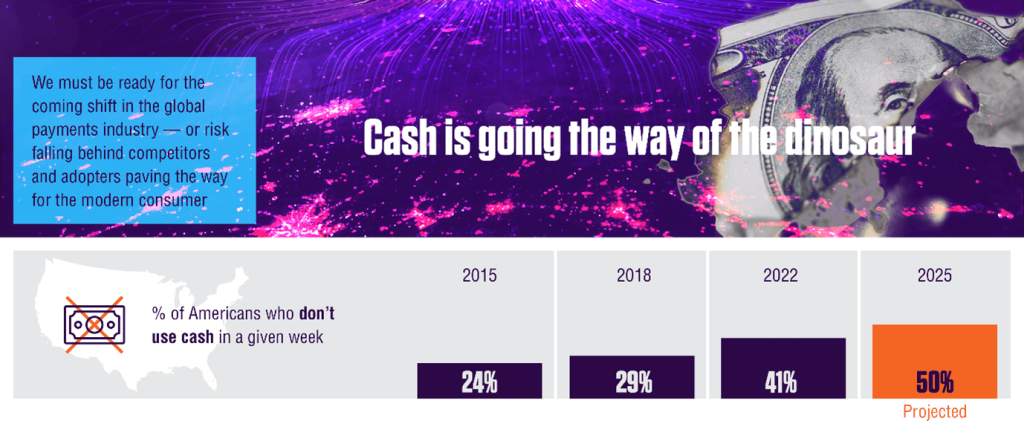
Paper money and physical transactions have lost relevance across the world, paving the way for the modern consumer – who prefer online buying, love throwing virtual goods into their e-shopping carts, and thrive on ‘drop at the door’ delivery options.
The global shift online
What accelerated this immense growth of digital payments was the COVID-19 pandemic, which forced companies and industries online, making room for a new, efficient, and secure way of transacting.
From the finance industry, to entertainment, sports, healthcare, and tourism – all sectors of society around the world were affected by the shift, which now also makes way for crypto and fiat currencies. One of industries most affected by the changing payment methods was online casinos. Did you know that 26% of people around the world gamble online on any given day? These are the people heavily reliant on safe online deposits and withdrawals. The great payment options that came into play broadened the transacting choices for people in different regions. Suddenly, there were many ways to send and receive money online. But the common are digital wallets (49%), credit or debit cards (32%), or account to account (9%).
Cryptocurrency and PayPal
And still new payment methods are coming in at lightning speed. In fact, already on the horizon are cryptocurrency payments (which includes digital currency kept on blockchain). For online gamblers these include crypto coins (like Bitcoin, Ethereum, Tether; crypto tokens; and NFTs (non-fungible tokens). These support smart contracts and are autonomous, unmodifiable, and irreversible payments from one account to another. For casinos, these methods ensure an elevated level of safety for players.
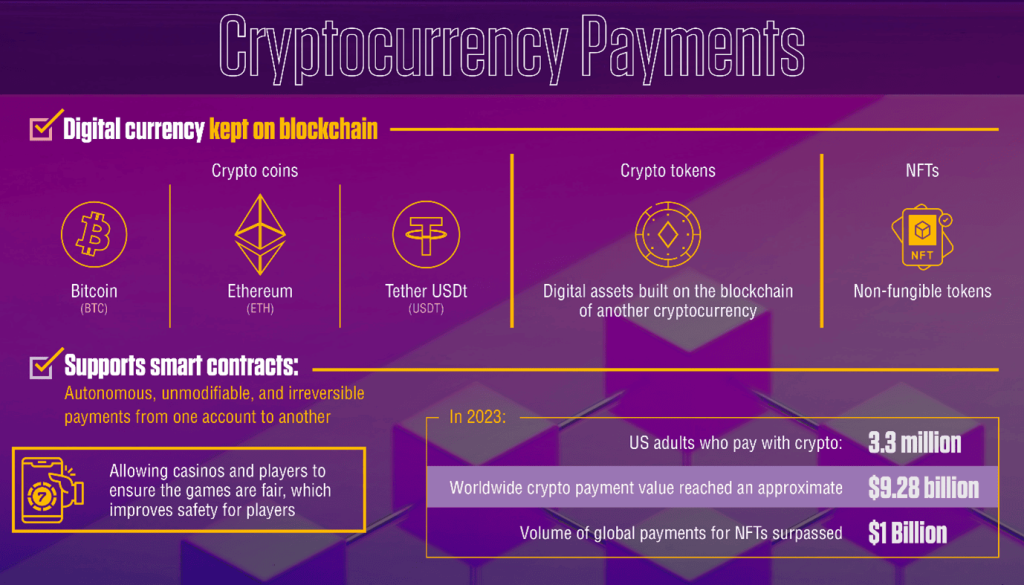
In 2023, 3.3 million US adults used crypto currency for payments. Globally crypto payments reached around $9.28 billion, while NFTs surpassed $1 billion.
Another growing payment method globally is PayPal. According to Statista, it had 431 million users by the end of Q2 2023. The value of the transactions processed reached US$337 billion. PayPal saw incredible growth over the past few years and as of March 2023, 91% of online users in Germany and 84% in Brazil were using PayPal for online casino payments. For United States, the figures stood at 81% and Canada at 85% respectively. By 2023, PayPal became legal in specific areas within Europe, India, Ireland, Japan, Latin America, Malaysia, North America, Netherlands, and Sweden. It relies on a Bank ID, Trustly and Plaid.
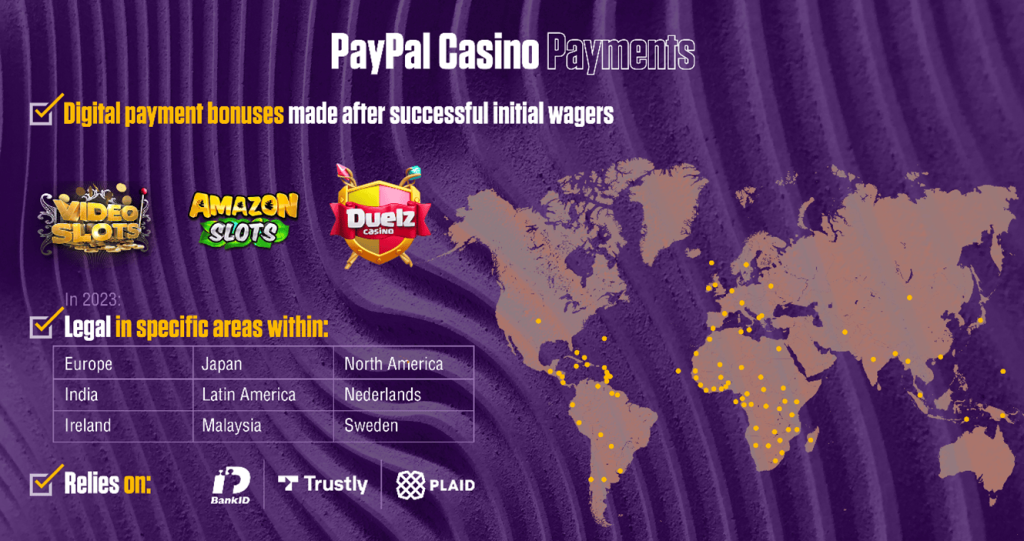
Another type of payment method on the horizon is Central Bank Digital Currencies (CBDC). These include DCash (Eastern Caribbean); e-CNY (China); eNaira (Nigeria); e₹ or eINR (India); and Digital Ruble (Russia).
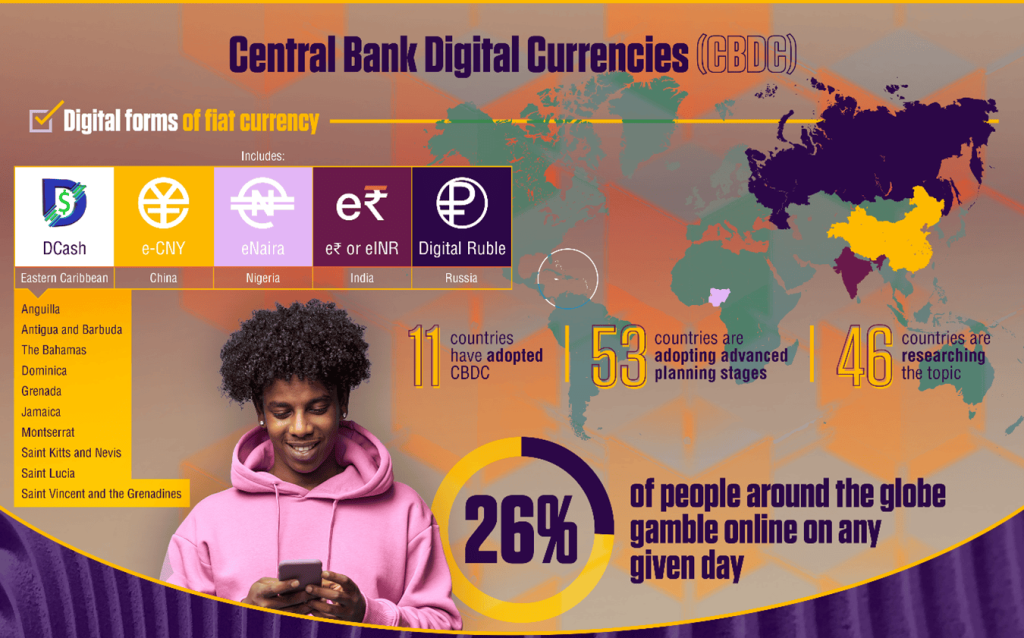
By 2023, some 11 countries had adopted CBDC including Nigeria, Anguilla, Jamaica, The Bahamas, Saint Kitts and Nevis, Antigua and Barbuda, Montserrat, Dominica, Saint Lucia, Saint Vincent and the Grenadines, as well as Grenada. Another 53 countries are already in advanced planning stages to adopt CBDC, while 46 others are still researching the topic.
The Predictions for Payments Has Never Been Brighter
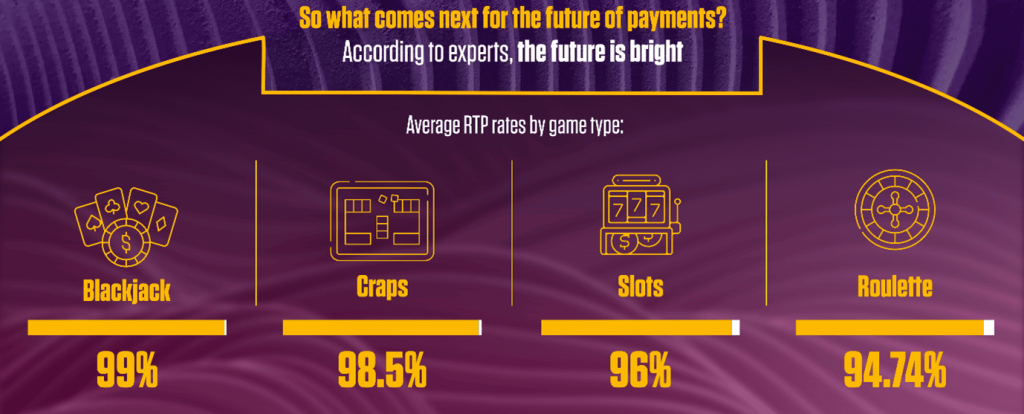
Nearly all global regions have seen increases in all payment revenues. APAC in 2020 stood at $611 billion in payment revenue and by 2025 this is expected to increase by 42% to $932 billion. North America’s payment revenue of $459 billion in 2020 is expected to hit $609 billion by 2025 (a 28% increase). Europe’s $237 billion in 2020 is projected to balloon by 26% to $307 billion by 2025, while LATAM’s $127 billion in 2020 will increase by 40% to $190 billion by 2025. The MEA region’s 2021 payment revenue of $64 billion is expected to grow by 27% to $84 billion by 2025.
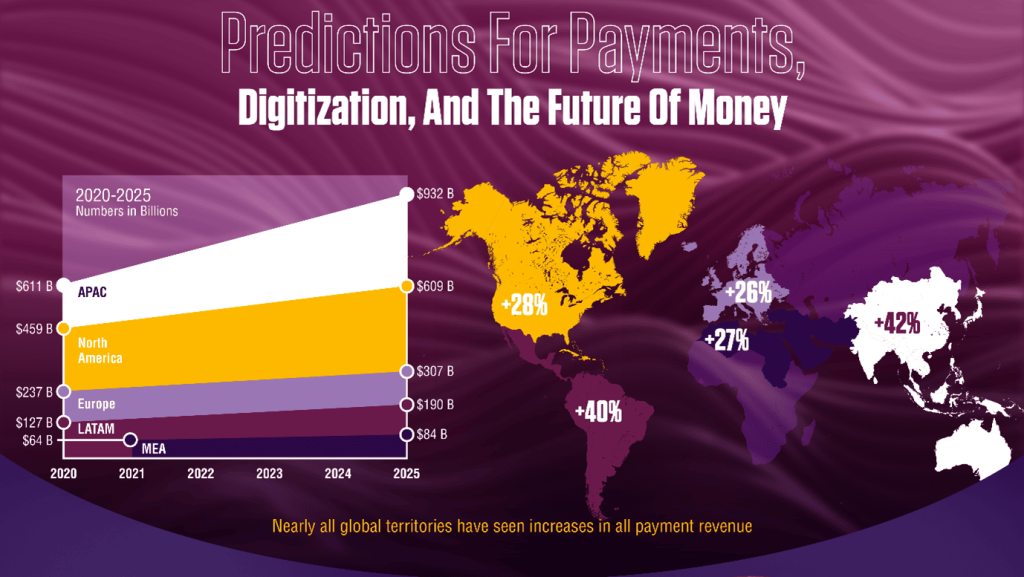
What this means is that the days of paper money have gone the way of the dinosaur. Physical transactions are long behind us and by 2030, analysts expect cashless transaction volumes to increase rapidly.
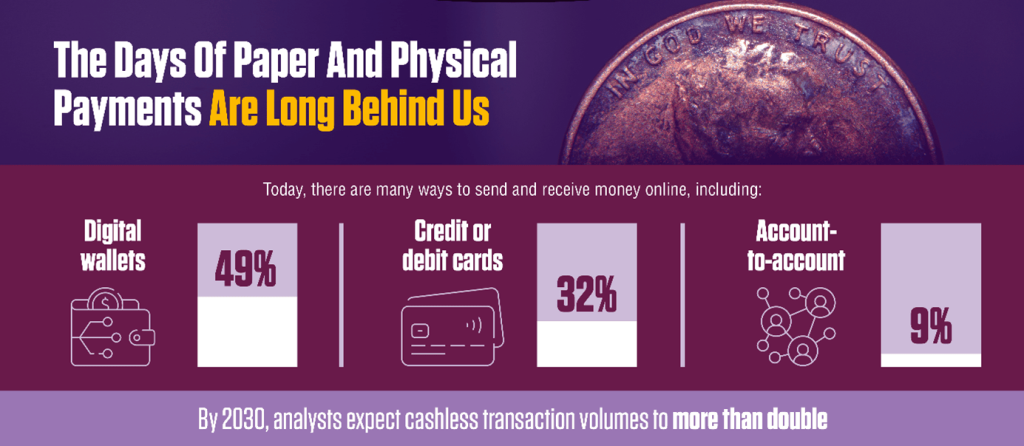
Companies and industries need to prepare for the future of digital payments or risk falling behind their competitors who are paving the way for the modern consumer. All industries and societies are affected, including online casinos and igaming enthusiasts. So, get in gear and do not be left behind. The future of digital payments is already upon us. Are you ready?
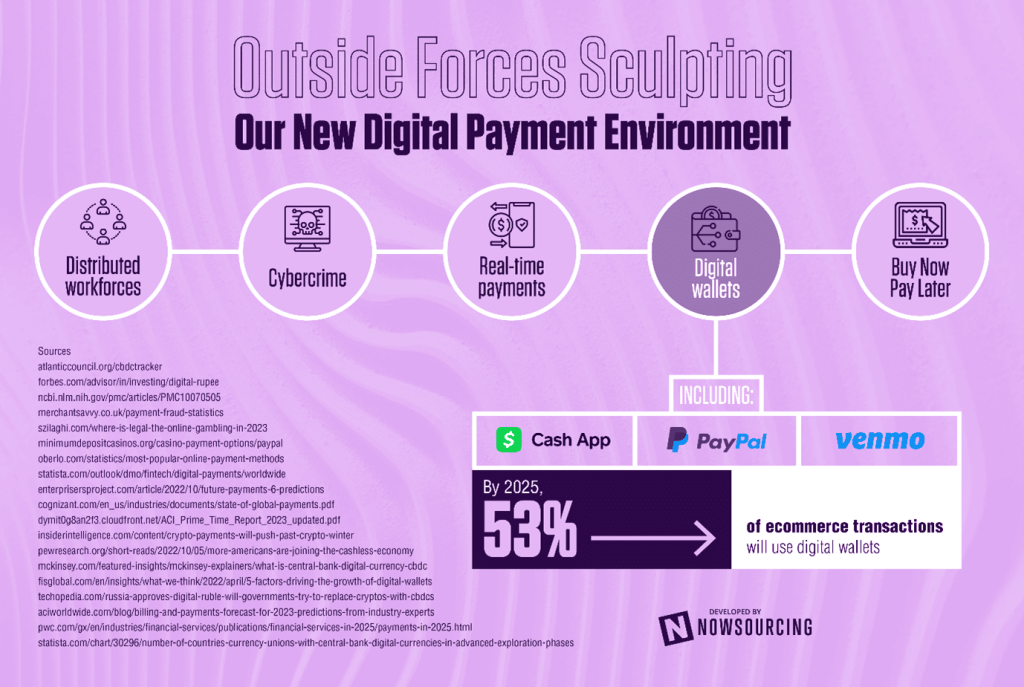
About MDC
MDC stands as a pioneer in the digital payment revolution, offering a leading resource for online casino enthusiasts. With digital wallets becoming increasingly prevalent in global e-commerce transactions and cashless transactions on the rise, MDC remains agile in adapting to these transformative changes. Rooted in responsible gaming, MDC provides a secure and welcoming space for the growing community of online gamblers worldwide.
References:
- atlanticcouncil.org/cbdctracker
- forbes.com/advisor/in/investing/digital-rupee
- ncbi.nlm.nih.gov/pmc/articles/PMC10070505
- merchantsavvy.co.uk/payment-fraud-statistics
- szilaghi.com/where-is-legal-the-online-gambling-in-2023
- minimumdepositcasinos.org/casino-payment-options/paypal
- oberlo.com/statistics/most-popular-online-payment-methods
- statista.com/outlook/dmo/fintech/digital-payments/worldwide
- enterprisersproject.com/article/2022/10/future-payments-6-predictions
- cognizant.com/en_us/industries/documents/state-of-global-payments.pdf
- dymit0g8an2f3.cloudfront.net/ACI_Prime_Time_Report_2023_updated.pdf
- insiderintelligence.com/content/crypto-payments-will-push-past-crypto-winter
- pewresearch.org/short-reads/2022/10/05/more-americans-are-joining-the-cashless-economy
- mckinsey.com/featured-insights/mckinsey-explainers/what-is-central-bank-digital-currency-cbdc
- fisglobal.com/en/insights/what-we-think/2022/april/5-factors-driving-the-growth-of-digital-wallets
- techopedia.com/russia-approves-digital-ruble-will-governments-try-to-replace-cryptos-with-cbdcs
- aciworldwide.com/blog/billing-and-payments-forecast-for-2023-predictions-from-industry-experts
- pwc.com/gx/en/industries/financial-services/publications/financial-services-in-2025/payments-in-2025.html
- statista.com/chart/30296/number-of-countries-currency-unions-with-central-bank-digital-currencies-in-advanced-exploration-phases